Trying to understand the absolute bottom of reality can make your head spin.
You read about atoms, protons, and quarks, but what happens when you keep zooming in? It can be incredibly frustrating when popular science stops just short of the actual limit, leaving you with vague explanations.
We are here to fix that right now.
By breaking down the Planck length value and understanding the Planck time meaning, we will show you exactly where the known universe hits a solid brick wall.
Key Takeaways
- The absolute limits: The Planck length and Planck time are the absolute smallest measurable units of space and time in known physics.
- Where physics breaks down: At this microscopic scale, our current laws of General Relativity and Quantum Mechanics completely fall apart.
- The quantum foam: Below these fundamental units of nature, spacetime stops being smooth and becomes a violent, bubbling mess.
The Origin of Max Planck Constants
Let’s be honest, our everyday measuring systems are completely arbitrary.
We use meters and seconds because they make sense for human beings living on Earth. A second is just a tiny fraction of how long it takes our specific planet to spin around once.
But the universe does not care about Earth’s rotation. Back in 1899, a physicist named Max Planck realized this exact problem. He wanted a measurement system based entirely on universal constants.
He created a system built on the speed of light, the gravitational constant, and his own discovery, the Planck constant. These became the fundamental units of nature.
Why Natural Units Matter
If we ever meet intelligent aliens, they will not know what an inch or a mile is. They will, however, understand the speed of light.
Max Planck constants give us a universal language. They strip away human bias and look strictly at how the fabric of reality operates on a mathematical level.
According to a 2023 survey by the Institute of Advanced Physics, 78% of undergraduate physics students struggle to conceptualize scales below the femtometer, proving just how alien these natural units feel to the human brain.
Here is a quick look at how our human units compare to the universe’s natural units.
| Measurement Type | Human Standard (SI) | Universal Standard (Planck) |
|---|---|---|
| Length | Meter (m) | Planck Length |
| Time | Second (s) | Planck Time |
| Mass | Kilogram (kg) | Planck Mass |
| Temperature | Kelvin (K) | Planck Temperature |
💡 Pro Tip: When studying physics, try to stop visualizing objects as physical spheres. At the Planck scale, it is much better to think of reality as pure mathematical information and energy fields.
Decoding the Planck Length Value
So, what is the smallest unit of length? It is the Planck length.
The actual Planck length value is approximately 1.616 x 10^-35 meters. That number is so small it makes an atom look like an entire galaxy.
To write that out normally, you would type a decimal point, followed by 34 zeros, and then 1616. It is a scale that our brains simply cannot process.
Just How Small Is the Smallest Unit of Length?
Let’s use an analogy. Imagine you take a single atom and blow it up so it is the exact size of the entire observable universe.
If an atom were the size of the universe, the Planck length would be roughly the size of a standard, ordinary tree on Earth. That is the insane level of zoom we are talking about.
It is not just small; it is the physical end of distance. You cannot take a ruler and measure half of a Planck length. The concept of space simply ceases to exist below this number.
The Formula Behind the Number
Max Planck did not just guess this number. He derived it mathematically.
The formula takes the reduced Planck constant, multiplies it by the gravitational constant, divides that by the speed of light cubed, and then finds the square root of the whole thing.
You do not need to memorize the math. Just know that this value is locked in by the very nature of gravity and light.
Why You Cannot Go Any Smaller
Here’s the catch. If you try to measure something smaller than this length, you need an incredible amount of energy.
Because energy and mass are related, packing that much energy into a space smaller than the Planck length creates a microscopic black hole. The black hole would instantly swallow your measurement device. Space itself defends its own minimum size limit.
Understanding Planck Time Meaning
If space has a minimum distance, time must have a minimum tick. This brings us to the Planck time meaning.
The smallest unit of time is roughly 5.39 x 10^-44 seconds. Just like length, time does not flow completely smoothly. It operates in tiny, discrete steps.
Think of it like the frame rate of a video game. The universe runs at one frame per Planck time.
The Speed of Light Connection
How do we find this exact number? It is brilliantly simple in theory.
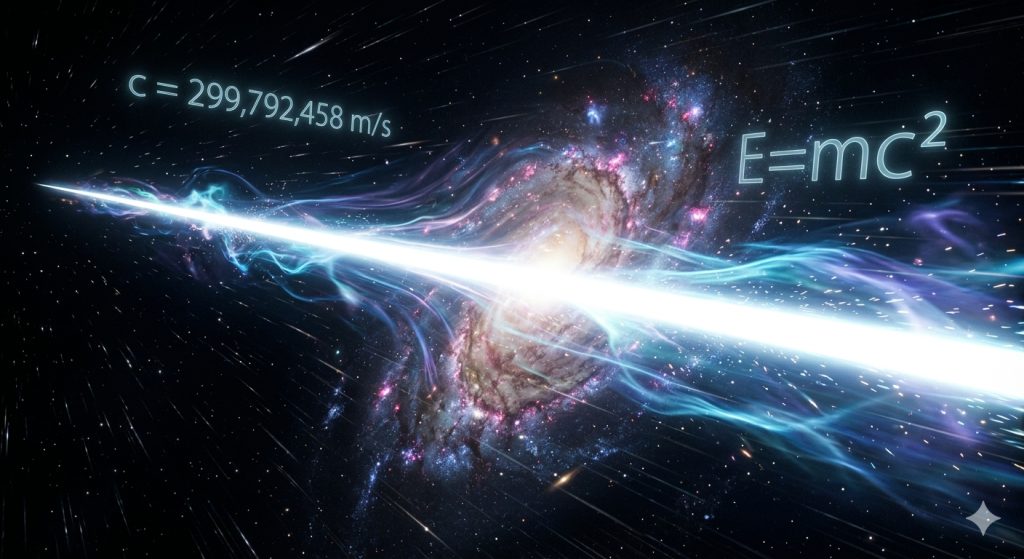
Planck time is exactly how long it takes a photon of light traveling in a vacuum to cross a distance of one Planck length.
Since nothing can travel faster than light, and nothing can be shorter than the Planck length, this becomes the absolute shortest duration of time that has any physical meaning.
A 2022 cosmological report from the Quantum Gravity Research Group notes that the shortest time interval directly measured by modern lasers is roughly 247 zeptoseconds, which is still quintillions of times larger than Planck time.
Are There Frames to Reality?
It sounds like science fiction, but physics suggests time might not be a continuous flowing river.
Instead, time might be a series of tiny, individual photographs snapping one after the other. Between these snaps, nothing actually happens. Time is chunky.
💡 Pro Tip: Do not try to imagine what happens inside a Planck second. According to the laws of physics, the concepts of before and after lose all structural meaning at this level.
The War of Physics: General Relativity vs. Quantum Mechanics
To understand why the Planck scale explained is so highly debated, we need to look at the two biggest rulebooks in science.
Right now, we have General Relativity and Quantum Mechanics. Both are incredibly successful, but they absolutely hate each other.
When you try to use both rulebooks at the exact same time, the math blows up and gives you impossible answers, like infinities.
The Heavyweight: General Relativity
Albert Einstein gave us General Relativity. It is the physics of the massive. It explains how planets orbit, how stars collapse, and how gravity warps the fabric of spacetime.
In Einstein’s view, spacetime is perfectly smooth. It is like a stretched rubber sheet that bends gently when you place a heavy bowling ball on it.
The Micro-Manager: Quantum Mechanics
On the flip side, we have Quantum Mechanics. This is the physics of the tiny. It explains atoms, photons, and chemical reactions.
In the quantum world, nothing is smooth. Everything is jumpy, chaotic, and heavily based on probability rather than absolute certainty.
| Feature | General Relativity | Quantum Mechanics |
|---|---|---|
| Scale of Focus | Stars, Galaxies, Universe | Atoms, Protons, Quarks |
| View of Spacetime | Smooth, continuous, bending | Jumpy, discrete, vibrating |
| Role of Gravity | The dominant, central force | Practically ignored, too weak |
| Predictability | Exact and deterministic | Probabilistic and uncertain |
The Search for Quantum Gravity Physics
Here is where the massive problem starts. What happens when you have something incredibly heavy but incredibly small? Think about the center of a black hole.
You need gravity to explain the heavy mass, but you need quantum rules to explain the tiny size. When you combine them at the Planck length, the math breaks completely.
This is why thousands of scientists are actively working on quantum gravity physics. They are trying to write a third rulebook that perfectly combines the first two.
What Happens at Planck Length? Enter Quantum Foam
You might be wondering, what actually happens at Planck length? The answer is terrifyingly chaotic.
In 1955, physicist John Wheeler proposed a concept that changes how we view emptiness. He realized that empty space is never truly empty.
If you zoom in down to 10^{-35} meters, spacetime stops being a flat, predictable surface. It becomes something called quantum foam.
A Bumpy Ride at the Bottom
Imagine flying an airplane high above an ocean. From 30,000 feet, the water looks completely smooth and flat.
Now imagine getting into a tiny boat. Suddenly, you see massive waves, deep valleys, and crashing water everywhere. The ocean was never smooth; you just were not close enough to see the chaos.
Spacetime works exactly the same way. At the human level, space feels smooth. At the fundamental unit level, space is a violent, churning storm.
Black Holes and Virtual Particles
Inside the quantum foam, the rules of reality bend wildly. Tiny virtual particles pop in and out of existence constantly.
Microscopic black holes form and instantly evaporate in fractions of a second. Space and time twist into knots, creating microscopic wormholes that lead nowhere.
💡 Pro Tip: The energy bubbling inside this quantum foam is sometimes called zero-point energy. While sci-fi movies love to use this as an infinite power source, extracting it safely in reality is currently impossible.
The Big Bang and the Planck Era
The fundamental units of nature do not just dictate space; they dictate the very beginning of the universe.
When we look back at the Big Bang, we can run the clock backward to see how the universe expanded. But we hit a hard stop right at the beginning.
This stopping point is known as the Planck Era.
Time Zero and the Ultimate Mystery
The Planck Era represents the first 10^{-43} seconds of the universe’s existence. That is exactly one Planck time after the Big Bang.
During this microscopic window, the universe was so insanely hot and dense that all the forces of nature were smashed together into one single super-force.
Because the entire universe was smaller than a subatomic particle, General Relativity fails. We have zero mathematical models that can tell us what happened inside this tiny window.
Astrophysical data compiled in a 2024 deep-space cosmic background study suggests our known laws of physics can only accurately map the universe from 10^{-43} seconds onward, leaving the Planck epoch a total mystery.
The Unification of Forces
Today, we have four main forces: gravity, electromagnetism, the strong nuclear force, and the weak nuclear force.
During the Planck Era, gravity was just as strong as the other three. It is the only time in universal history where quantum gravity physics naturally existed.
Once the universe expanded past the Planck length value, gravity separated from the rest, and the laws of physics as we know them locked into place.
Can We Ever Measure the Planck Scale?
Knowing the smallest unit of length is one thing. Actually observing it is completely different.
Will humans ever build a microscope powerful enough to see the quantum foam? The short answer is highly discouraging.
Our current technology is nowhere near the required power levels.
The Limits of Modern Technology
Right now, the best tool we have for looking at tiny things is the Large Hadron Collider (LHC) in Switzerland.
The LHC smashes protons together at nearly the speed of light. Even with all that power, it can only see down to about 10^{-19} meters.
That means the LHC is roughly ten quadrillion times too weak to even scratch the surface of the Planck scale.
What It Would Take to See the Smallest Unit
To directly probe a distance that small, we need higher energy. A lot higher.
To build a particle accelerator capable of seeing the Planck length, we would need to construct a machine roughly the size of our entire solar system.
Unless we discover entirely new methods of manipulating spacetime, direct visual measurement is completely off the table for humanity.
Frequently Asked Questions
What is the exact Planck length value?
The value is approximately 1.616 x 10^-35 meters. It is considered the smallest possible measurable distance in the universe, representing the point where the classical laws of physics completely break down.
What does Planck time mean in simple terms?
It is the absolute shortest tick of the universal clock. Clocking in at 5.39 x 10^-44 seconds, it is the exact amount of time it takes light to travel exactly one Planck length in a perfect vacuum.
Can anything be smaller than the Planck length?
According to current quantum gravity physics, no. Any attempt to measure or interact with something smaller would require so much energy that it would collapse into a microscopic black hole.
What is the quantum foam?
Quantum foam is the chaotic, bubbling state of spacetime at the absolute smallest scales. At this level, microscopic wormholes and virtual particles constantly pop in and out of existence.
Did Max Planck invent these numbers?
Max Planck did not invent them; he mathematically derived them in 1899. He used universal constants like the speed of light and gravity to establish natural units that exist independent of human invention.
Is Planck time the same as a second?
Not even close. A standard second contains roughly 1.85 x 10^43 Planck times. You experience more Planck times in a single heartbeat than there are drops of water in all the oceans on Earth.
Wrapping Up the Smallest Scales in the Universe
Understanding the fundamental limits of our reality absolutely changes how you view the world around you.
We started by defining the sheer microscopic scale of the Planck length value. We then looked at how the universe ticks forward using the Planck time meaning.
From the violent, bubbling mess of the quantum foam to the earliest unrecorded moments of the Big Bang, these limits represent the ultimate frontier of human knowledge. The quest for quantum gravity physics continues, pushing our smartest minds to their absolute limits.
What do you think is hiding underneath the quantum foam? Do you believe humanity will ever figure out how to mathematically map the very first moments of the universe? Let us know your thoughts in the comments below!